Stormuring: The Method That Turns Workplace Stress Into Results
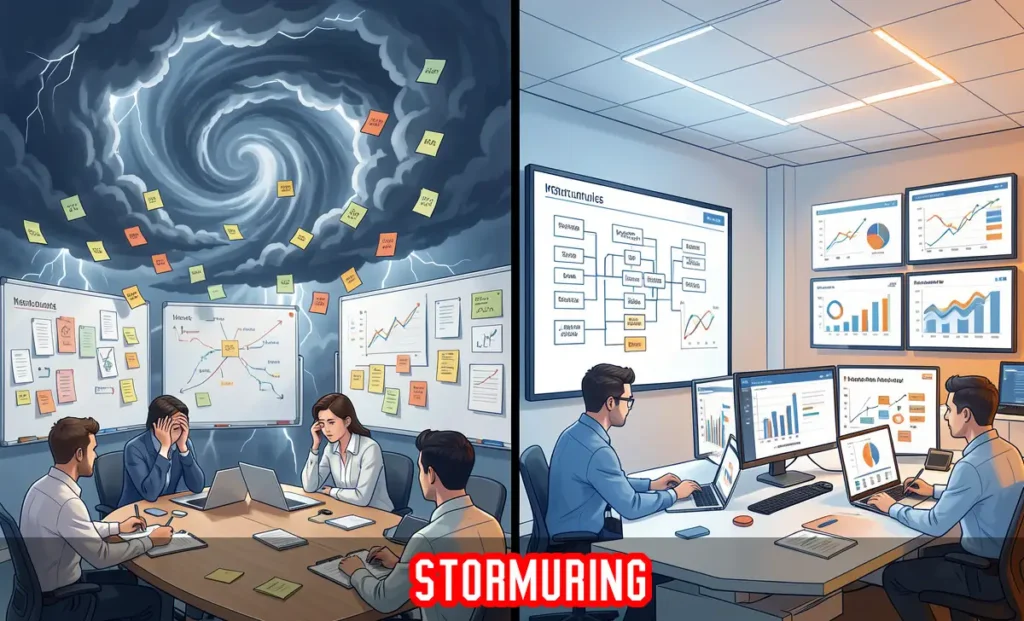
Stormuring is a structured problem-solving method that transforms stress and chaos into actionable solutions. Unlike traditional brainstorming, it uses defined criteria, rapid prototyping, and evidence-based evaluation to turn ideas into measurable results within organizations.
Traditional brainstorming sessions pile up sticky notes but rarely produce real change. Teams gather, ideas fly around the room, and nothing happens afterward. You waste hours generating suggestions that never get tested or implemented.
Stormuring fixes this problem.
This approach merges creative thinking with disciplined execution. It recognizes that stress and pressure can fuel innovation when you channel them through the right framework. Teams using stormuring move from abstract ideas to concrete solutions faster than conventional methods allow.
Contents
What Stormuring Actually Means
The term blends “storm” and “enduring”—capturing both the turbulent energy of brainstorming and the sustained focus needed to implement change. Think of it as controlled chaos with a clear purpose.
Research from Yale University (2010) revealed that traditional group brainstorming produces fewer quality ideas than individuals working alone. Groupthink dominates. Loud voices overshadow quiet thinkers. No structure exists to evaluate which ideas deserve resources.
Stormuring addresses these flaws head-on. It adds clarity where brainstorming creates confusion. It builds frameworks where others rely on hope.
How Stormuring Works in Practice
The method follows six core steps that prevent ideas from dying in meeting rooms.
Step 1: Define the Problem Precisely. Write a single sentence describing what you need to solve. Include success metrics. Skip vague goals like “improve customer satisfaction.” Instead, try “reduce customer support response time from 24 hours to 4 hours while maintaining 90% satisfaction scores.”
Step 2: Gather Diverse Voices. Pull people from different departments and experience levels. Engineers, marketers, interns, executives—each brings a unique lens. Rotate who facilitates the session to prevent hierarchy from silencing good ideas.
Step 3: Generate Ideas Under Time Constraints Set a 20-minute timer. Quantity matters here, but only for this phase. Write everything down without judgment. The pressure creates urgency that breaks through mental blocks.
Step 4: Evaluate Using Clear Criteria. Stop relying on gut feelings. Establish 3-5 measurable criteria before the session starts. Examples include cost, time to implement, customer impact, technical feasibility, and alignment with company goals. Score each idea against these benchmarks.
Step 5: Build Rapid Prototypes. Take the top 2-3 ideas and test them quickly. This might mean running a week-long pilot, creating a mockup, or testing with a small customer segment. Evidence beats opinion every time.
Step 6: Implement and Measure. Choose the winning solution based on prototype results. Deploy it. Track the metrics you defined in step one. Document what worked and what failed to improve your next cycle.
Real Applications Across Industries
A healthcare organization tackled medication adherence using stormuring. They defined success as “increase adherence by 15% among diabetes patients within 90 days.” After evaluating ideas against cost and behavioral research, they tested a gamification approach. Results showed 18% improvement.
A software company faced high customer churn. Stormuring revealed users didn’t understand existing features. Instead of building new ones, they created better onboarding. Churn dropped 23% in three months.
Why Stress Becomes an Asset
Stormuring reframes pressure as useful input rather than something to avoid. When deadlines tighten or stakes rise, teams naturally focus harder. The method provides channels for that energy.
Traditional approaches tell people to “relax and think creatively.” That advice ignores how human brains actually work under stress. We become sharper, more decisive, and better at filtering weak ideas when consequences matter.
The key is adding structure to prevent stress from becoming chaos. Time-boxed sessions create urgency without overwhelm. Clear evaluation criteria prevent stress from triggering poor decisions. Rapid prototyping tests ideas before major resource commitments.
Stormuring vs Traditional Brainstorming
| Aspect | Traditional Brainstorming | Stormuring |
|---|---|---|
| Problem definition | Vague, open-ended | Specific, measurable |
| Idea generation | Unlimited time, all ideas equal | Time-boxed, focused divergence |
| Evaluation | Subjective, influenced by seniority | Criteria-based, data-driven |
| Implementation | Rarely happens | Built into the process |
| Results | Lists of ideas | Tested, deployed solutions |
| Timeframe | Ongoing, no endpoint | Defined cycles with clear outcomes |
Common Mistakes to Avoid
Skipping Problem Definition: Spend 20% of your session clarifying what you’re solving. A well-defined problem guides everything.
Evaluating Too Early: Let divergent thinking run its course. Critique kills unconventional ideas.
Voting by Committee: Use predetermined criteria, not popularity contests.
Slow Prototyping: Build minimum versions fast. You need quick feedback, not perfection.
Forgetting the documentation record learnings from each cycle. Failed prototypes teach valuable lessons.
Building a Stormuring Culture
Organizations that succeed share common traits. Leadership participates without dominating. Teams test bold ideas quickly. Failure during prototyping becomes data, not career risk.
Start small with one contained problem. Document results. Build credibility before scaling. Train facilitators who balance creative and analytical thinking. Create templates for problem statements and evaluation criteria.
Measuring Success
Track three key metrics: time from problem identification to solution deployment, solution effectiveness against original goals, and resource efficiency compared to traditional approaches.
Most teams see faster implementation cycles within three sessions. Initial stormuring attempts feel awkward as people adjust to the structure. By the third round, the process becomes natural.
Solution quality typically exceeds brainstorming results because evaluation happens before resource commitment, not after. You test ideas when they’re cheap to modify or abandon.
Getting Started Tomorrow
Pick a problem your team discusses repeatedly without solving. Write a one-sentence problem statement with measurable success criteria. Invite 5-7 people from different backgrounds. Block 90 minutes.
Prepare 3-4 evaluation criteria beforehand. Share them with participants before the session. Run through all six steps without skipping prototyping.
Review results after two weeks. Did metrics move? What surprised you? Apply those lessons next time.
Stormuring transforms how teams approach complex challenges. It replaces hope-based planning with evidence-based execution, giving both creative chaos and analytical rigor the space they need to work.
FAQs
What makes stormuring different from design thinking?
Design thinking emphasizes empathy and user research. Stormuring focuses on rapid evaluation and implementation within organizations. Both value iteration, but stormuring compresses timelines and prioritizes measurable outcomes over deep exploration.
How long should a stormuring session last?
90-180 minutes works for most problems. Complex challenges may need multiple sessions, but each should maintain tight time constraints to preserve energy and focus.
Can remote teams use stormuring effectively?
Yes. Use collaborative tools for idea generation, shared spreadsheets for criteria-based scoring, and video calls for discussion. The structure actually helps remote teams stay focused better than open-ended video brainstorms.
When should I not use stormuring?
Skip it for simple problems with obvious solutions or when you need extended research before generating ideas. Stormuring works best for complex challenges where multiple viable approaches exist.
How many ideas should we generate?
Aim for 15-30 in the divergent phase. Fewer suggests you stopped too soon. More becomes difficult to evaluate properly. Quality matters more than quantity, but you need enough options to find innovative solutions.
Elmo Baker
Elmo Baker is a dedicated journalist and researcher with a passion for simplifying complex topics for readers. His writing helps people make informed decisions through practical, easy-to-understand content. As a proud team member of WhizWeekly, Elmo ensures his articles are both helpful and reliable.
633 stories →