
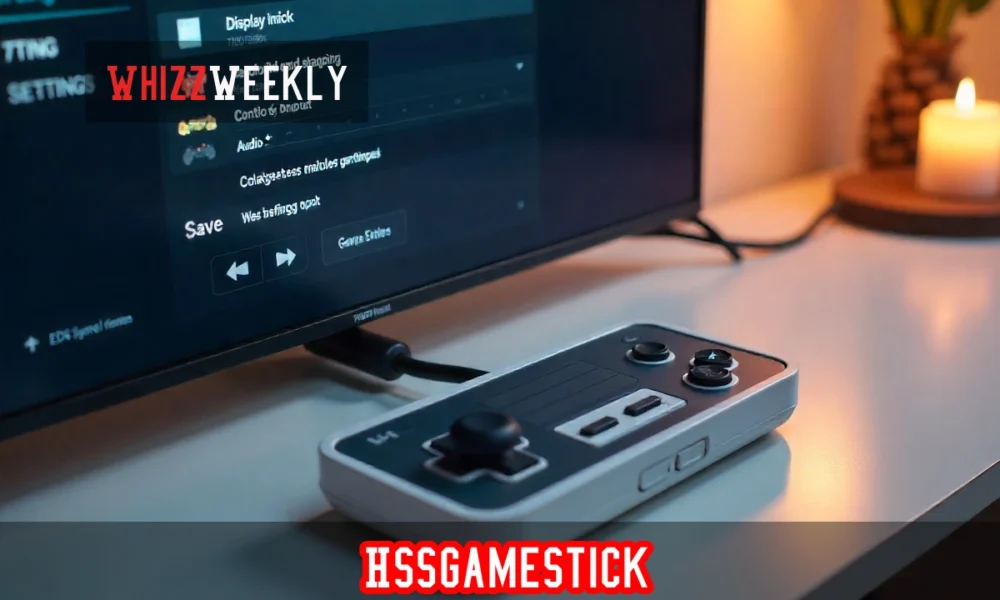
Manual Settings HSSGameStick: Complete Configuration Guide
The HSSGameStick manual settings menu lets you customize display resolution (720p/1080p), adjust controller sensitivity and button mapping, configure audio output, and manage game saves. Access settings by pressing the gear icon on the main menu after connecting your device via HDMI.
What Makes HSSGameStick Manual Settings Essential
The HSSGameStick connects to your TV through HDMI and comes preloaded with thousands of classic games. Factory settings work for basic gameplay, but manual configuration unlocks better performance across different displays and play styles.
Manual settings improve gaming precision and responsiveness by allowing users to adjust sensitivity levels for smoother control. Without these adjustments, you might experience stretched visuals, audio lag, or unresponsive controls that diminish the retro gaming experience.
Manual configuration addresses three core problems: display mismatch between your TV’s native resolution and default output, controller lag from generic sensitivity settings, and audio sync issues with external speakers.
Accessing the Settings Menu
Turn on your HSSGameStick and wait for the main interface to load. Use the D-pad on your controller to navigate to the gear icon labeled “Settings” or “System Settings.” Press the A button to enter the menu.
The settings menu contains options for display, audio, controller setup, language, and save preferences. Navigation uses directional buttons to scroll through categories and the A button to select options.
Display Configuration for Your TV
Match your GameStick’s resolution with your TV’s native resolution to avoid blurry visuals. Most modern TVs support 1080p, while older displays may work better at 720p.
Navigate to Display, then Resolution. Select from available options:
720p HD — Best for older HDTVs and smaller screens under 32 inches. 1080p Full HD — Standard for most modern TVs from 2010 onward 4K — Only use if your TV explicitly supports 4K input
Test each setting by loading a game and checking text clarity. Blurry menus or stretched character sprites indicate a resolution mismatch.
Choose 4:3 for classic experience or 16:9 for widescreen stretch. Original retro games used 4:3 displays, so this ratio shows games as developers intended. The 16:9 option fills modern widescreen TVs but may distort character proportions.
If parts of the game menu appear cut off at screen edges, enable overscan adjustment. This setting pulls the image inward to compensate for TVs that automatically crop edges.
Audio Output Configuration
Sound quality depends on correct output routing. Choose audio output source between HDMI for TV speakers or external for soundbar and headphones.
Go to Audio Settings and select your output:
HDMI Audio — Sends sound through your TV’s built-in speakers. External Audio — Routes to connected soundbar, stereo system, or headphones Bluetooth — Pairs with wireless headphones (if supported by your model)
External audio systems deliver richer sound for music-heavy games like platformers and RPGs. If you notice audio arriving slightly after visual actions, increase audio delay by 50-100ms increments until sync improves.
Controller Configuration and Sensitivity
Proper controller setup reduces input lag and improves responsiveness. Adjusting controller settings is essential for gamers seeking precise control.
Customize button layout per game or emulator to match your play style. Access Input Settings and select Configure Input to remap buttons.
Common remapping includes:
Fighting Games — Map special moves to shoulder buttons for faster combos. Platformers — Swap jump and run buttons to match personal muscle memory. Shooters — Assign fire to shoulder triggers for ergonomic comfort
High sensitivity ensures quick responses necessary for fast-paced games, while low sensitivity provides accurate control for strategy games. Set sensitivity between 1-10 based on game type. Action games and shooters benefit from 7-9 sensitivity for rapid movements. Puzzle games and turn-based RPGs work better at 3-5 for precise cursor control.
Fix drifting issues by reducing joystick dead zones. If your character moves without touching the analog stick, increase the dead zone percentage. If inputs feel delayed, reduce the dead zone for a more immediate response.
Emulator-Specific Settings
The HSSGameStick runs multiple emulators for different console systems. Many models use RetroArch as their base. Access the Quick Menu during gameplay by pressing Select and Start simultaneously.
Core Options — Change emulator-specific features like frameskip and texture filtering. Shaders — Add CRT filters, scanlines, or smoothing for an authentic retro appearance. Save States — Create multiple save points beyond standard game saves
Custom input profiles can be saved per emulator, so the SNES layout won’t interfere with PlayStation setup. Navigate to Save Config On Exit and enable it to preserve game-specific settings.
Storage and Game Management
Organize your game library through the file manager. ROMs are usually sorted by folder, like roms/nes/ and roms/snes/.
Insert a USB drive with ROM files and copy them through File Manager to add games. Make sure ROM files match supported formats for each system.
Enable autosave on exit to automatically preserve progress when exiting a game. This prevents data loss if you forget to manually save. The system stores multiple save slots per game.
Network and Performance Settings
Some HSSGameStick models support basic network features. Open Network Settings, select your WiFi network, enter the password, and connect to check for firmware updates.
Network connection enables downloading game metadata, box art, and system updates. Update frequency recommendations vary, but checking quarterly prevents missing critical performance patches.
Enable VSync to eliminate screen tearing if you notice horizontal lines during fast camera movement. Disable it if you experience input lag, as VSync can add 1-2 frames of delay.
Troubleshooting Common Issues
No Display Output — Check the HDMI cable connection at both ends. Try a different HDMI port on your TV. Verify TV input source matches the port you’re using.
Controller Not Responding — Replace batteries or recharge the controller, then re-pair following setup steps. Check for interference from other wireless devices.
Audio Problems — Double-check that your audio output source is correctly set. Switch between HDMI and external audio to identify if the problem lies with your TV or external speakers.
Game Performance Issues — Update firmware and clear unnecessary background apps. Reduce shader effects and disable frameskip if games run too slowly.
Firmware Updates and Backup
Check the manufacturer’s website for updates, download them to a USB drive, and reboot the system with the USB inserted. Back up your SD card before updating.
Updates can add new emulator cores, fix compatibility issues, and improve system stability. Many users report significant improvements in UI speed and emulator performance after major updates.
Copy SD card contents or export config files to backup settings safely. Factory reset returns all settings to defaults. Use this when selling your device or if settings changes cause system instability.
Recommended Settings by Use Case
Casual Retro Gaming: Resolution 1080p, Aspect Ratio 16:9, Controller Sensitivity 5, Audio HDMI, Shaders light scanlines.
Competitive Play: Resolution 720p for lower input lag, Aspect Ratio 4:3 for accurate hitboxes, Controller Sensitivity 8-9, Audio External with low latency, Shaders disabled.
Family Multiplayer: Resolution 1080p, Aspect Ratio 16:9, Multiple user profiles enabled, Audio HDMI for TV speakers, Simplified controls with turbo function.
Key Takeaways
Manual settings transform the HSSGameStick from a basic plug-and-play device into a customized retro gaming system. Display configuration eliminates visual problems, controller adjustments improve responsiveness, and emulator settings enable authentic gameplay experiences.
Start with display and audio settings since these affect every game. Then configure controller sensitivity based on your most-played genres. Advanced users should explore emulator cores and shader options to recreate specific console aesthetics.
Frequently Asked Questions
Do manual settings void my warranty?
Using built-in menu options doesn’t void the warranty. Avoid firmware flashing or unauthorized modifications.
Can I reset to defaults if I make mistakes?
Yes, System Settings includes a Reset to Defaults option that restores factory settings.
Will higher resolution drain more power?
Resolution changes have minimal impact on power consumption compared to processor-intensive features like shaders.
How often should I update firmware?
Check for updates every 3-4 months or when experiencing glitches.
Can I use different controllers?
Most plug-and-play accessories are supported through USB connection under input settings.