
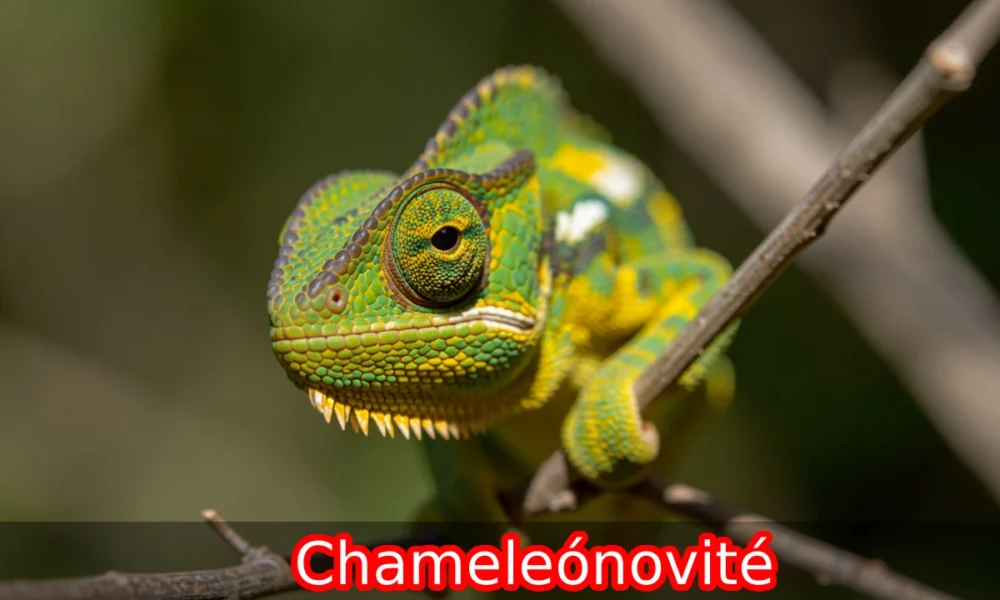
What Is Chameleónovité? The Biology Behind Color-Changing Reptiles
Chameleónovité (family Chamaeleonidae) is a group of specialized lizards found across Africa, Madagascar, southern Europe, and parts of Asia. There are over 200 known species. They are identified by their zygodactyl feet, independently rotating eyes, projectile tongues, and the ability to change skin color through structural light reflection.
What Chameleónovité Actually Means
Chameleónovité is the Slovak and Czech zoological name for the family Chamaeleonidae — the biological grouping that includes all true chameleons. The word follows standard taxonomic naming used across Central and Eastern European biology texts.
This family sits within the order Squamata, the large group of scaled reptiles that also includes snakes and other lizards. Within Squamata, chameleons belong to the suborder Lacertilia and the infraorder Iguania.
There are currently 202 recognized species in the family Chamaeleonidae, spread across two main genera: Chamaeleo (Old World chameleons) and Furcifer (found mostly in Madagascar). Madagascar alone hosts roughly half of all known species, making it the global center of chameleon diversity.
How Color Change Actually Works
Most people believe chameleons change color to hide from predators. That is partially true, but the science shows a more specific picture.
Chameleons have two layers of specialized cells in their skin called iridophores. These cells contain tiny nanocrystals arranged in a lattice structure. When a chameleon is calm, the crystals sit close together and reflect blue wavelengths of light. When the animal is excited, stressed, or responding to a rival, muscles pull the skin taut. The lattice expands, the spacing between crystals increases, and the skin reflects longer wavelengths — red, orange, and yellow.
This means color change is not pigment-based. It is structural. The chameleon is not producing new color. It is physically altering how light bounces off its skin. Research published in Nature Communications (2015) by Teyssier et al. confirmed this mechanism using electron microscopy and light spectroscopy.
Color change serves three main functions: communication between individuals, temperature regulation (darker colors absorb more heat), and camouflage as a secondary use. Males display the most intense color shifts, particularly during mating or territorial disputes.
Physical Traits That Set Chameleónovité Apart
Chameleons have several anatomical features found nowhere else in the reptile world.
Their feet are zygodactyl, meaning the toes are fused into opposing groups — two toes on one side, three on the other. This gives them a pincer-like grip ideal for grasping branches. No other lizard family has this exact foot structure.
Their eyes are covered by a fused, cone-shaped eyelid, leaving only a small pupil exposed. Each eye can rotate independently through a 180-degree arc and provides monocular vision of nearly the full surrounding area. When focusing on prey, both eyes converge to give binocular depth perception. This shift from panoramic to focused vision happens in under a second.
The tongue is arguably the most mechanically impressive feature. In Rhampholeon species, the tongue accelerates at up to 264 meters per second squared — roughly 41 times gravitational force. It reaches full extension in 0.07 seconds. The tongue tip is coated in a mucus with a viscosity approximately 400 times that of human saliva, allowing it to grip insects on contact. A study in Scientific Reports (2017) measured the adhesive force of chameleon tongues relative to body weight and found they could capture prey up to 30% of their own body mass.
Where Chameleónovité Species Live
The highest concentration of species is in sub-Saharan Africa and Madagascar. The veiled chameleon (Chamaeleo calyptratus), one of the most studied species, originates from Yemen and Saudi Arabia. The Parson’s chameleon (Calumma parsonii), the largest chameleon by body mass, lives only in the rainforests of eastern Madagascar.
A small number of species live in southern Europe. Chamaeleo chamaeleon is found in southern Spain, Portugal, and parts of Greece. These populations face habitat pressure from tourism development and agriculture.
Chameleons are almost entirely arboreal. They move slowly and rely on stillness as a defense. Their metabolism is lower than that of most lizards of comparable size, which reduces their need to hunt daily but makes them sensitive to temperature fluctuations.
Reproduction and Lifespan
Most chameleons are oviparous — they lay eggs. Clutch sizes vary widely. Jackson’s chameleon (Trioceros jacksonii) is viviparous, giving birth to 8 to 30 live young after a gestation period of about six months.
Egg incubation periods are unusually long. Parson’s chameleon eggs incubate in soil for 18 to 24 months before hatching — one of the longest incubation periods of any reptile. During this time, the eggs remain sensitive to soil temperature and moisture.
Lifespan in the wild averages 3 to 10 years, depending on species. Veiled chameleons in captivity can live up to 8 years with proper husbandry. Males of many species die shortly after the breeding season, partly due to the physiological cost of intense color displays and territorial aggression.
Why Chameleónovité Matter to Science
Chameleons are studied across multiple fields. Their color-change mechanism has informed research in photonics and materials science. Engineers have looked at iridophore structures when designing adaptive camouflage materials and reflective coatings.
Their tongues are studied in biomechanics for insights into high-speed elastic energy storage. The tongue works on a spring-loaded mechanism: a cylindrical accelerator muscle wraps around a central bone, compresses like a coiled spring, and releases. This system stores and releases energy faster than muscle contraction alone could achieve.
In conservation biology, chameleons serve as indicator species. Their sensitivity to habitat change, microclimate variation, and pesticide exposure means their population health reflects broader ecosystem conditions. The IUCN Red List currently lists over 30 chameleon species as vulnerable, endangered, or critically endangered, largely due to deforestation and illegal collection for the pet trade.
FAQs About Chameleónovité
Do chameleons change color to match their background?
Not primarily. Color change mainly signals mood, temperature needs, or social status. Camouflage is a secondary function, and many species rely more on stillness than color for hiding.
How many species are in the Chamaeleonidae family?
Over 200 recognized species exist, with new ones still being described. Madagascar holds the highest species density globally.
Are chameleons dangerous to humans?
No. Chameleons are not venomous and rarely bite. When handled, they may hiss or gape, but they pose no direct threat to people.
Can chameleons hear?
Chameleons lack external ears and were long thought to be deaf. Research from 2013 (Proceedings of the Royal Society B) showed they can detect low-frequency vibrations through bone conduction, though their hearing range is narrow.
Why are chameleons hard to keep as pets?
They require precise humidity, temperature gradients, UVB lighting, and live prey. Stress from improper handling or environment causes rapid health decline. They are not recommended for inexperienced reptile keepers.