Pedro Escarfullery: Baseball Career, Bio, and College Record
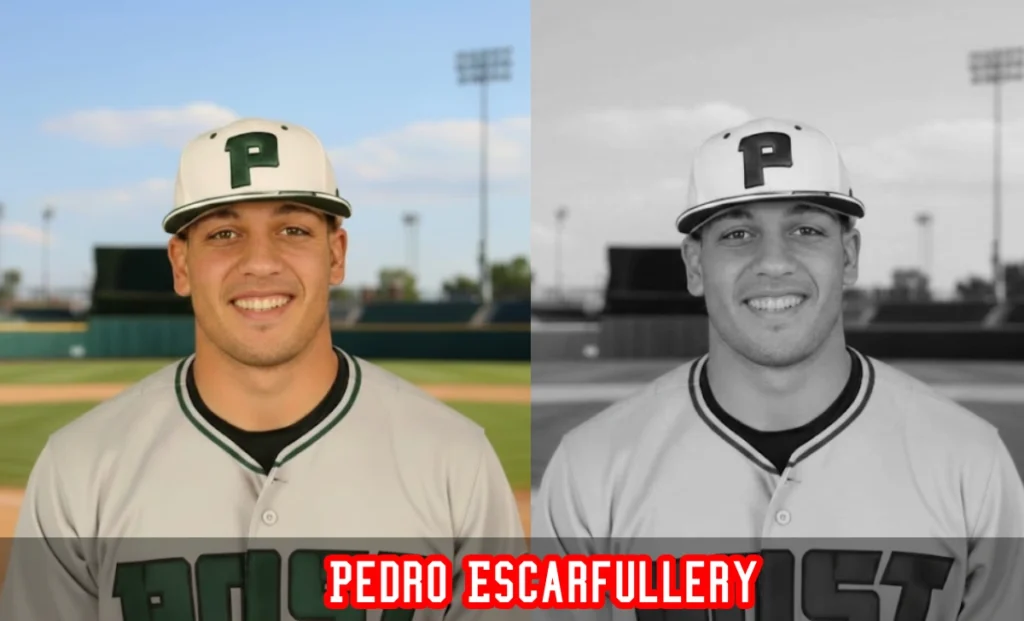
Pedro Escarfullery was one of the most physically gifted amateur baseball prospects to come out of Waterbury, Connecticut — a player whose size, arm, and bat put him on scouting radar long before he played a single college game.
Here is everything on record about his career, from Crosby High School through two collegiate programs.
Contents
Quick Bio
| Detail | Information |
|---|---|
| Full Name | Pedro Escarfullery |
| Date of Birth | April 29, 1990 |
| Birthplace | Waterbury, Connecticut, USA |
| High School | Crosby High School |
| College | Post University; Fisher College |
| Position | Outfielder (OF); Right-Handed Pitcher (RHP) |
| Jersey Number | #31 (Post University), #5 (Fisher College) |
| Height | 6’3″ |
| Weight | 200–225 lbs |
| Parents | Duarte Escarfullery, Angela Arciniega |
| Siblings | Dante, Esther, Daniela |
Early Life in Waterbury, Connecticut
Escarfullery was born on April 29, 1990, and raised in Waterbury, Connecticut, by his father, Duarte Escarfullery, and mother, Angela Arciniega. He grew up with three siblings — his brother Dante and sisters Esther and Daniela — in a household where discipline set the tone.
Waterbury is not a city that generates college baseball recruits at volume. For a player from that market to earn scouting attention, the physical tools have to be obvious and consistent. Escarfullery cleared that bar early. By the time he was playing at Crosby High School, he already stood 6’3″ and weighed around 200 pounds — measurements that placed him well ahead of most players in his draft class.
High School Scouting and the Class of 2009
Perfect Game — the largest amateur baseball scouting platform in the United States — logged Escarfullery in its national database as part of the class of 2009. His profile listed him as both a right-handed pitcher and an outfielder, a dual classification that reflected genuine versatility rather than roster convenience.
During a 2007 showcase, his fastball was clocked at 81 mph — a solid number for a high-school-aged arm, particularly from a player who was being evaluated as much for his bat and outfield tools as his pitching. Getting into the Perfect Game system at all means scouts watched him perform and decided he was worth tracking. That is not a given for players from smaller markets.
His recruitment by Post University followed directly from that attention. The coaching staff identified him as one of the higher-rated prospects available in their recruiting class.
College Career at Post University
Escarfullery enrolled at Post University in Waterbury and joined the Eagles baseball program. The 2011 Post University roster confirms him as number 31, listed as an outfielder. He completed his freshman season, then returned the following year as a redshirt freshman — a common path for prospects who benefit from an extra year of physical and competitive development.
Head coach A.J. McNamara was direct about what he saw in the player: “Pedro has tremendous upside. He can hit for power, he can run, and has one of the strongest arms I’ve seen in a while.”
Coaching staff rarely lead with arm strength when assessing outfield prospects. Speed, bat speed, and instincts come up first. When arm strength is the headline, it signals something specific about a player’s ceiling in the outfield — and his potential value on the mound.
His weight progressed from 200 pounds as a freshman to 210 pounds as a redshirt freshman. In collegiate baseball, that kind of steady physical development often corresponds with increased plate discipline, harder contact, and better velocity on the mound. It is one of the clearest markers of a prospect who is taking the training side seriously.
To put the physical development in perspective: a player gaining 10 pounds of functional weight between ages 18 and 20 while maintaining speed is doing something right in the weight room. Most collegiate programs track this closely because it predicts performance trajectory better than early stats alone.
Transfer to Fisher College and the Fisher Falcons
After his time at Post University, Escarfullery transferred to Fisher College in Boston, where he joined the Fisher Falcons baseball program. At Fisher, he wore jersey number 5 and was listed primarily as a right-handed pitcher — a shift from his outfielder classification at Post University.
Fisher College competes at the NAIA level, which operates alongside NCAA Division II and III programs. NAIA baseball draws players skilled enough to compete at the college level but who, for academic, financial, or personal reasons, chose a smaller program over a Division I path. It is a legitimate competitive environment, and players who contribute at the NAIA level have put in real work to get there.
The pitcher/outfielder versatility Escarfullery brought gave the Falcons roster options most players cannot provide. A right-handed arm with outfield experience understands how batted balls move, how to read angles, and how to work within a defensive alignment — all of which carry value on the mound, even if it is rarely discussed in conventional scouting language.
Playing Style and Physical Tools
Escarfullery’s profile was built on three tools that scouts and coaches consistently referenced: power, arm strength, and athleticism at 6’3″+. At his listed weight of 210–225 pounds during his college years, he was physically built for impact in the batter’s box.
As an outfielder, a strong arm forces runners to make conservative decisions. At the collegiate level, where aggressive base running is part of nearly every opponent’s game plan, an outfielder who can throw accurately and with velocity changes the risk calculation on every single hit to the outfield. It does not show up in a box score, but coaches who run their programs on base-to-base efficiency know exactly what it is worth.
His versatility on the mound added a separate layer of value. Pitchers who have played the outfield carry a different kind of spatial awareness than those who come up purely through the rotation. They have tracked fly balls, worked through defensive alignments, and developed instincts about how hard contact moves through space — a background that can quietly translate into better pitch sequencing and location work.
Career Stats and Professional Record
Full-season statistics from Escarfullery’s time at both Post University and Fisher College are not in any publicly accessible database. Roster pages confirm his presence, his jersey numbers, and his listed positions — but ERA, batting average, on-base percentage, and strikeout totals are not on public record.
This is standard for NAIA and smaller collegiate programs. Many do not maintain searchable statistical archives, and players can complete full careers without leaving a public stat line. The absence reflects program infrastructure, not performance quality.
No public record shows Escarfullery being selected in the MLB amateur draft, signing with a professional organization, or attending a major league combine. That outcome places him in the company of the overwhelming majority of college players. According to NCAA research, fewer than nine in every 1,000 high school baseball seniors will eventually be drafted by a Major League team. Escarfullery competed seriously at two collegiate programs and drew legitimate scouting attention — that is a meaningful athletic career by any honest measure.
Conclusion
Pedro Escarfullery’s documented baseball career spans roughly three years of collegiate play across two programs, preceded by a high school profile notable enough to land him in Perfect Game’s national database. He was recruited as a premium prospect, developed his physical tools at the collegiate level, and competed in a dual role that most players cannot fill.
The public record is clear enough: a talented amateur baseball player from Waterbury, Connecticut, who earned his roster spots, drew attention from a respected scouting platform, and brought measurable tools to the programs he played for.
If you are researching his background for a profile, a personal connection, or sports history purposes, the records at Post University, Fisher College, and the Perfect Game database are the three most reliable starting points for further verification.
FAQs
Where is Pedro Escarfullery from?
He was born and raised in Waterbury, Connecticut. He attended Crosby High School before playing collegiate baseball at Post University and Fisher College.
What position did Pedro Escarfullery play?
He was listed as an outfielder at Post University and as a right-handed pitcher at Fisher College. His scouting profile at the high school level identified him as both.
Did Pedro Escarfullery play professional baseball?
No public record shows him signing with a professional organization or being selected in the MLB amateur draft.
What colleges did Pedro Escarfullery attend?
He attended Post University in Waterbury, Connecticut, then transferred to Fisher College in Boston, where he played for the Fisher Falcons.
How tall is Pedro Escarfullery?
He stands 6’3″ and was listed at between 200 and 225 pounds across his collegiate career.
Elmo Baker
Elmo Baker is a dedicated journalist and researcher with a passion for simplifying complex topics for readers. His writing helps people make informed decisions through practical, easy-to-understand content. As a proud team member of WhizWeekly, Elmo ensures his articles are both helpful and reliable.
633 stories →