Polymarket’s April 7 Verdict Is Starting to Look Like a Fire Alarm

First came the eerie bets. AP reported that at least 50 new wallets piled into “Yes” on a U.S.-Iran ceasefire before Trump announced one on April 7; for those wallets, these were the first recorded Polymarket bets, ruling out the usual narrative of seasoned users catching a whisper, and some generated six-figure profits within hours of the announcement. The Washington Post highlighted the same burst of highly specific trades, noting that some traders got paid fast while others were left hanging because the war’s end still looked shaky and the 14-day silence criterion was nowhere close to being met on paper.
Reuters added an even darker echo outside Polymarket: on April 7, traders placed about $950 million in oil bets just hours before Trump announced the ceasefire, one of several remarkably well-timed macro trades now under scrutiny by observers asking whether the same informational edge leaked into multiple venues simultaneously.
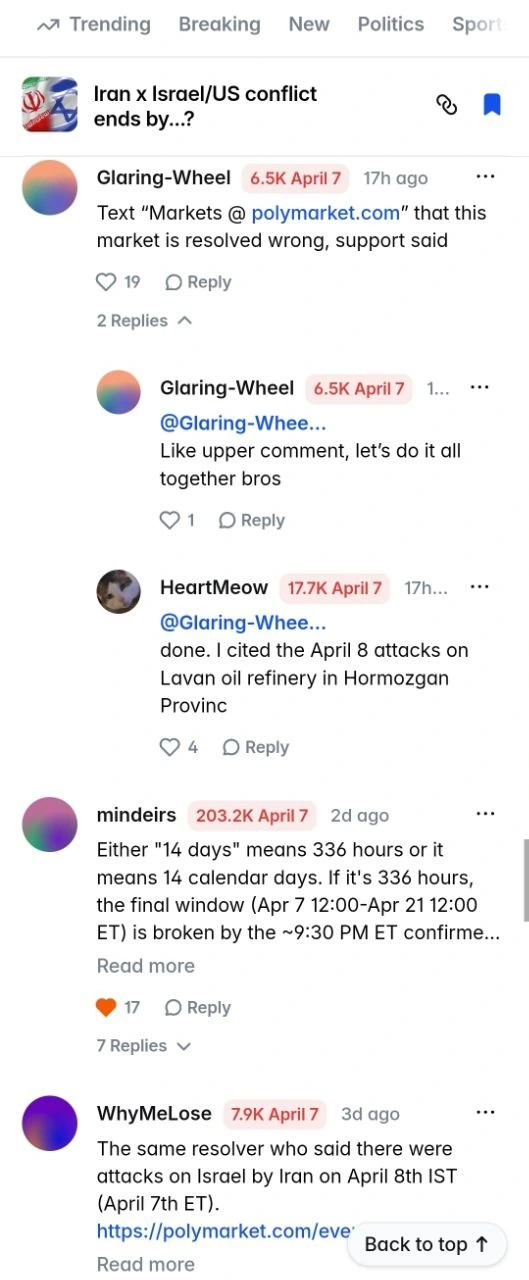
Then came the rule stretch. Polymarket says a second dispute can escalate to UMA’s token-holder review, and the April 7 market now shows two proposed “Yes” outcomes, two disputes, and “Final review” — the exact sequence the escalation path was designed for, and one that hands final say to a voting process rather than to any single arbiter. The rules say a “Yes” outcome requires a continuous 14-day period without qualifying military action, beginning by the specified end date and lasting through noon ET on the 14th calendar day. Critics argue there is only one way to force that result, given what actually happened on the ground: pretend April 7 counts as a quiet day, collapsing the “calendar day” requirement into something closer to “part of a day” and silently shaving hours off the 336-hour window the rules themselves construct.
Reuters’ timeline makes that interpretation look explosive. Strikes were intensifying as the 8 p.m. EDT deadline approached, and more than an hour after Trump’s announcement, Israel said Iranian missiles were still incoming and Israeli media reported Israeli retaliation against launch sites — hard, reported events, not speculation. Under a standard regulatory definition, a calendar day is a full 24 hours, measured from midnight to midnight; the term leaves no room for a “partial calendar day” carve-out.
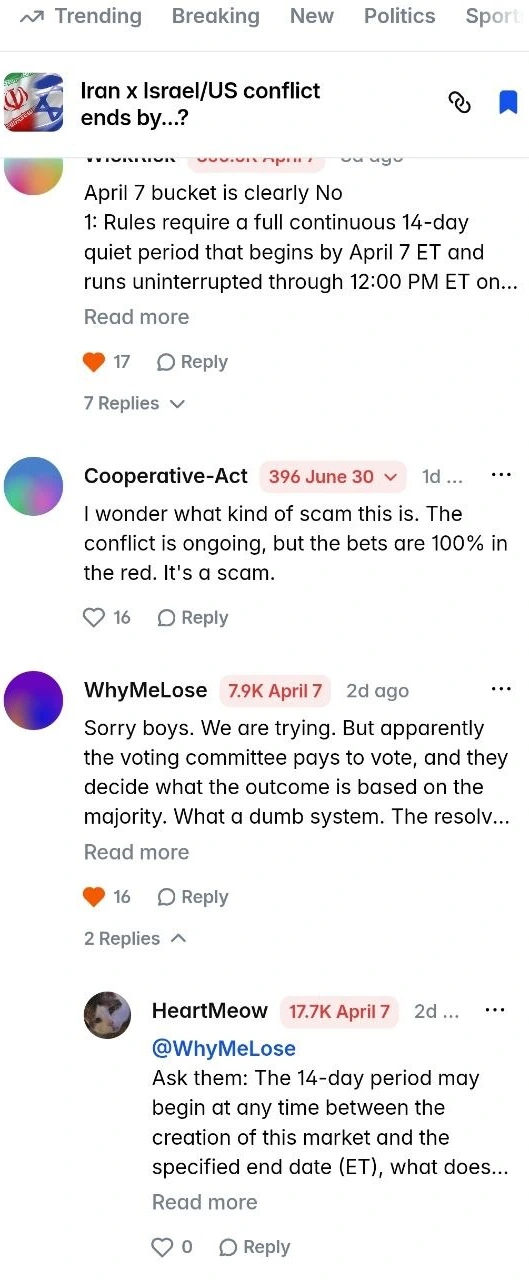
By that logic, a silence period that begins only after combat fades late on April 7 cannot cleanly reach noon ET on April 21, and the arithmetic short-falls by roughly eight hours — a gap too large to handwave as rounding. Public blockchain data cannot identify who owned the suspicious Polymarket wallets, and absent a subpoena, there is no way to pierce the pseudonymity. But in a market with more than $51.6 million tied to the nearest three “ends by” buckets, the mix of uncanny pre-announcement bets and a hyper-generous reading of April 7 is enough to make fears of a trader-influenced unfair outcome feel rational, not fringe — and loud enough that the UMA voters now holding the final call are reading the same headlines as everyone else.